JAPAN 1976
Caravelli and his Grand Orchestra:
- Caravelli
The Secret of the Caravelli Sound
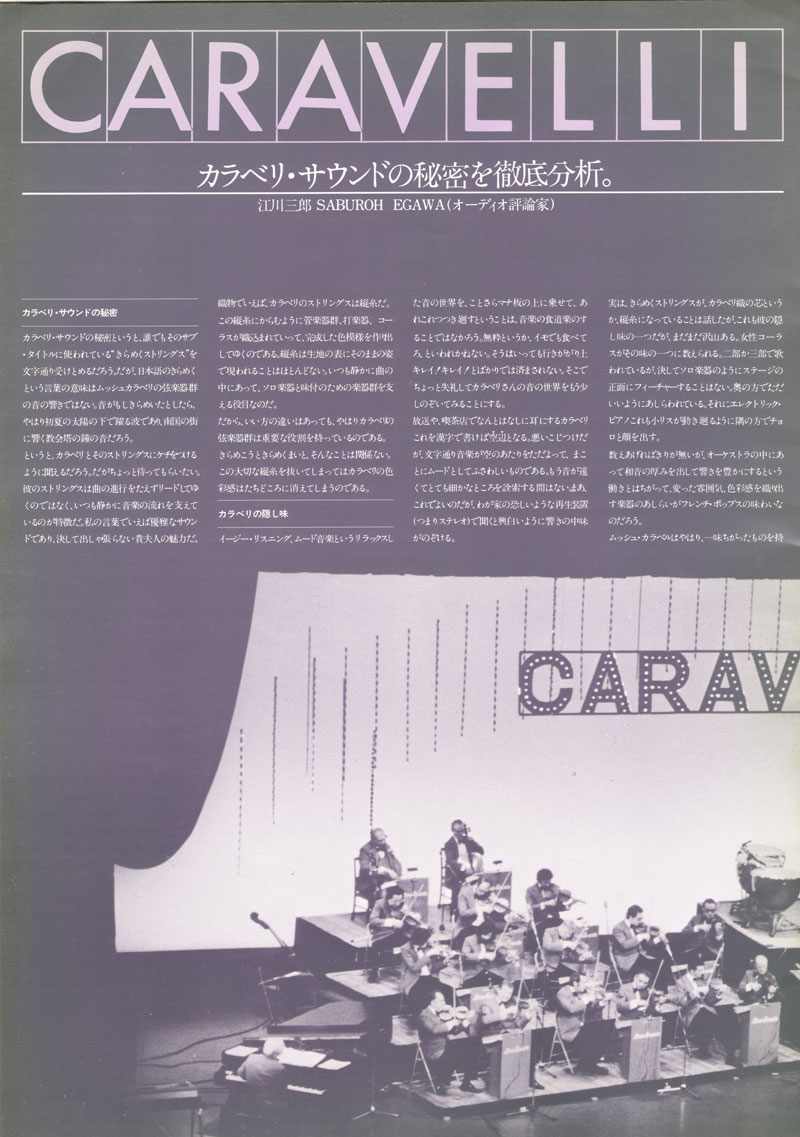
When we talk about the secret of the Caravelli sound, everyone will likely take the subtitle, "Sparkling Strings," literally. However, the Japanese word "sparkling" doesn't refer to the sound of Monsieur Caravelli's string section. If there were a sound that sparkled, it would surely be the waves dancing under the early summer sun, or the sound of church bells ringing in a tropical town.
This might sound like I'm criticizing Caravelli and his strings. But wait a moment. His strings don't constantly lead the progression of the music; rather, they quietly support the flow of the music. In my words, it's an elegant sound, the charm of a noble lady who never tries to stand out.
To use a textile analogy, Caravelli's strings are the warp threads. The wind instruments, percussion, and chorus are woven into these warp threads, creating the finished pattern. The warp threads rarely appear in their original form on the surface of the fabric. They are always quietly present within the music, supporting the solo instruments and the groups of instruments that add flavor.
Therefore, although the way it's expressed may differ, Caravelli's string section undeniably plays a crucial role. Whether it sparkles or not is irrelevant. Removing this essential warp thread would instantly vanish Caravelli's sense of color.
Caravelli's Secret Ingredient
To scrutinize the relaxed world of easy listening and mood music, putting it on a cutting board and nitpicking it, is not the mark of a true musical connoisseur. It's rather tasteless, almost to the point of being told to go eat potatoes. However, simply praising it as "beautiful! beautiful!" isn't enough. So, let's take a moment to peek a little further into Caravelli's world of sound.
The Caravelli music we often hear on radio or in cafes—if written in kanji, it would be "空辺" (kūhen), meaning "sky edge." It's a bit of a stretch, but literally, the music seems to float around the sky, making it perfectly suited to the mood. The sound is so distant now that there's no time to scrutinize the finer details. Well, that's fine, but when I listen on my rather frighteningly high-quality playback system (i.e., stereo), I can glimpse the depths of the resonance.
Actually, I mentioned that the shimmering strings form the core, or warp, of Caravelli's weave—this is one of his secret ingredients, but there are many more. The female chorus is one of those flavors. It's sung in the second or third part, but it's never featured prominently on stage like a solo instrument. It's simply used in the background, skillfully incorporated. And then there's the electric piano—it pops its head out from the side like a little squirrel scurrying around.
The list goes on and on, but unlike the role of instruments in an orchestra—adding depth to the harmonies and enriching the sound—the way they weave a unique atmosphere and sense of color is perhaps what gives French pop its distinctive flavor.
Monsieur Caravelli truly possesses something different.
French Tone
Of course, the main character in the Caravelli sound is Monsieur Caravelli, but the soloists featured among the members are very unassuming. Studio musicians never have their names appear on mood music albums; they are the unsung heroes. However, once they take on a solo part, they have their own distinct style, singing even the smallest phrases perfectly. This is something you'd expect from France, the land of wind instruments.
He's playing a trombone. The trumpeter is probably a renowned musician as well.
The oboe and soprano saxophone players are likely from first-class classical orchestras. His remarkably stable playing and relaxed demeanor greatly enhance the enjoyment of the music.
I noticed something interesting. No matter where I looked, I couldn't find a clarinet. And no bassoon either. However, perhaps the bassoon was hidden amongst the other low-pitched instruments and I simply couldn't hear it. But why is there not a single clarinet solo? French military bands are full of clarinets, even playing the role of violins in orchestras. Because of this, France has many virtuosos, and even more resonant instruments. If the clarinet is always absent from Caravelli's sound, then there must be some very specific reason.