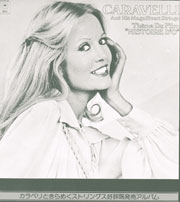
JAPAN 1976
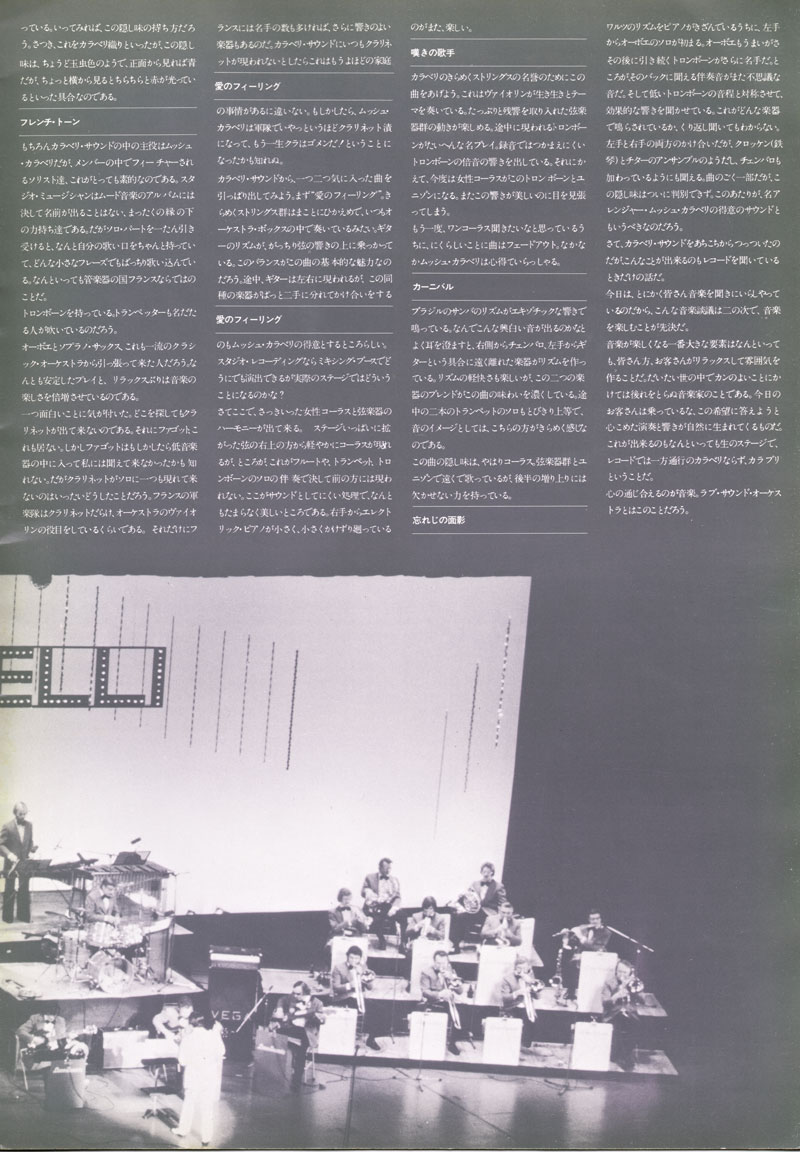
Caravelli and his Grand Orchestra:
- Caravelli
Feelings of Love
To scrutinize the relaxed world of easy listening and mood music, putting it on a cutting board and nitpicking it, is not the mark of a true musical connoisseur. It's rather tasteless, almost to the point of being told to go eat potatoes. However, simply praising it as "beautiful! beautiful!" isn't enough. So, let's take a moment to peek a little further into Caravelli's world of sound.
Perhaps Monsieur Caravelli was so immersed in the clarinet during his time in the military that he decided he never wanted to play it again!
Let's pull out one or two of my favorite pieces from Caravelli's sound. First, "Feelings of Love." The shimmering strings are truly understated, as if always playing within an orchestra pit. The guitar rhythm sits firmly on top of the string's resonance. This balance is probably the fundamental charm of this song. Midway through, the guitar appears on both the left and right, and these similar instruments suddenly split into two groups to engage in a call-and-response.
The Lamenting Singer
I'll dedicate this piece to the glory of Caravelli's sparkling strings. The violin plays the theme with vibrant energy. The rich reverberation of the string section is delightful. The trombone that appears midway through is a masterful performance. It captures the trombone's overtones, which are difficult to reproduce in recordings. Then, the female chorus joins in unison with the trombone. This sound is breathtakingly beautiful.
Just as you're wishing to hear another chorus, the piece frustratingly fades out. Monsieur Caravelli certainly knows what he's doing.
Carnival
The Brazilian samba rhythm resonates with an exotic sound. Listening carefully to understand how such an intriguing sound is produced, you realize that instruments far apart—a harpsichord on the right and a guitar on the left—are creating the rhythm. The lightness of the rhythm is enjoyable, but the blend of these two instruments deepens the flavor of this piece. The two trumpet solos in the middle are exceptionally fine, and the overall sound is more sparkling.
The secret ingredient in this piece is definitely the chorus. It sings in unison with the string section from a distance, but it plays an indispensable role in the rising intensity of the second half.
Unforgettable Image
As the piano keeps the waltz rhythm, the oboe solo begins in the left hand. The oboe is skillful, but the trombone that follows is even more masterful. However, the accompaniment heard in the background is also a mysterious sound. And it creates an effective resonance, symmetrical to the low pitch of the trombone. Even after listening repeatedly, I can't figure out what instrument is producing it. It's a call and response between the left and right hands, and it sounds like an ensemble of clockenwood and zither, and I even hear a harpsichord involved. It's only a small part of the piece, but I'm still unable to identify this secret ingredient. This is perhaps what could be called the signature sound of the renowned arranger, Monsieur Caravelli.
Now, I've touched upon the Caravelli sound from various angles, but this kind of thing is only possible when listening to a record.
Today, everyone has come to listen to music, so this kind of musical discussion is secondary; enjoying the music is the priority.
The most important element in making music enjoyable is, without a doubt, the audience's relaxation and the creation of a pleasant atmosphere. Musicians are generally known for their keen intuition. When they sense that the audience is engaged, a heartfelt performance and sound naturally emerge, in response to that expectation. This is something that can only be achieved on a live stage; on a record, it's not a one-way communication of Caravelli, but rather a "Caravelli-esque" performance.
Music is about connecting hearts. This is what a "Love Sound Orchestra" truly means.